- a discussion paper by Geoff Crocker
Technology Market Strategies
Technology has a pivotal role in the process of economic development. Through its effect on productivity, technology has changed the course of economics to allow the population subsistence theories of Malthus and the capitalism disaster theories of Marx to be avoided.
Technology and 'know how' is embodied in human education, in communications and transportation infrastructure, in physical capital equipment and software, in industrial processes, and in new product and service creation and functionality. These channels for the implementation of technology are the levers for advancing standards of living.
And yet, although technology is such an economic driver, the economics of technology are little understood. Not only in academic economics, but also in productive industry, management of technology in a market economy remains an obscure art. Technology is a major macro contributor to consumer surplus and to producer profit, driving the economic system forward, but industrial companies are as often takers as they are makers of their technology context. Achieving the optimal allocation in the development and sourcing of technology across the structure of global industry is critical to cosmic economic development and success, and yet this pattern emerges in a relatively unmanaged way considering its strategic importance to the global economy and to individual producer profitability.
Technology is variously defined as enabling, generic, application, engineering, or product technology, and each in turn has a variety of potential sources within an industrial company, or among its competitors and collaborators, or in other industry sectors, or else in universities, research institutions and consortia.
In a globally competitive market, price/performance measures will determine market shares and corporate profitability, and technology will have a great impact both on price through optimal manufacturing technology, and performance through technology applied into advanced product functionality and design. Equally, collaborative models can be applied both to product market positioning, and to technology development and sourcing.
Current trends in the globalisation of the market economy open new opportunities for technology strategy as well as creating new risks. The opportunities are that increased external sourcing of technology appears a cost effective way of offering leading edge products into global markets. Whole economies especially in south east Asia have benefitted from such technology transfer and licensing. Generic technologies are available from market supply sources. Industry / university technology collaboration is actively promoted by government schemes. But the corresponding threat is that of the zero sum game. As each company faces a short term micro incentive to buy in technology or to buy in trained labour, so the spread of such behaviour across the whole economy threatens to lead to under-investment in technology development. Partial analyses which show technology migrating typically up the value chain of service operations and manufacturing industry must ask where the technology development responsibility is ultimately lodged in today's global competitive markets.
The Technology Strategy
Each industrial company has a strategic choice in terms of technology development and sourcing. This choice is widening in the present context of global market access and restructuring of the value chain in many industries. The prime issue is for technology development paths to be managed to support the company's defined set of business objectives. In a world where focus on core activities is a competitive necessity to corporate survival and success, the inherent tendency of technology development to lead towards diversified outcomes - ever more so as 'basic' research is in advance of and detached from product development - creates strong a priori conditions for the operation of a technology transfer market. It is perhaps the infancy of this technology transfer market which inhibits investment in technologydevelopment by amplifying the risk of redundancy of outcome to the R&D process. Such redundancy easily arises when commercial business management strategies and scenarios evolve in shorter time circuits than successful technology development, or when company 'champions' of some technology project move job within and between companies. A technology transfer market of extensive coverage with a mature set of trading rules has yet to emerge to provide the risk cover against technology outcome redundancy.
Such a market can be shown operationally as
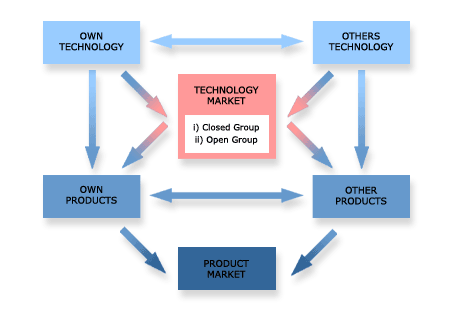
In the absence of such a market, companies face difficult trade off decisions armed with low information probability distributions in allocating R&D investment. Which technology development path to follow and how to source technology are prime corporate decision issues. Reduced technology development effort may increase current profitability at the expense of long term positioning. Out sourcing technology may have a similar effect in reducing the value added ownership element in a firm's products. On the other hand, technology embodied in capital equipment, in infrastructure, in human education and in industrial process design has long been acquired from external commercial suppliers and from the public domain.
The following diagram shows a typical choice set along the value chain of an industry sector.

The Corporate Technology Strategy
Is then defined as

There will be increased emphasis on the development and application of a methodology of this kind for optimising technology market strategy as businesses seek to harness the enhanced technology crucial to global economic development and corporate profitability in a cost effective and competitive way.
References
Rosenberg et al Technology and the Wealth of Nations, Stanford 1992
Dosi et al Technical Change and Economic Theory, Pinter 1988
 |
|
| Copyright © Technology Market Strategies 2003 | |
| tel UK | +44 (0)7770 585 031 |
| tel Moscow | (+7 095) 103 7800 |
| geoff.crocker@tms.eu.com | |